AI – Tool or a Better Mousetrap?
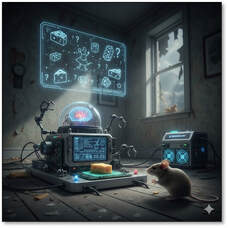
The Great Digital Divide
We live in a divided world where polarization has become the norm and an open mind the exception. While politics is the usual playing field for such a divide, the technology world has supplied us with a new one over the last few years, AI. Some, particularly those developing the technology, believe AI is unlike any other technology advancement and will change the way humanity will evolve for centuries to come. Others believe it is a scourge that will push humanity to a secondary position and eventually morph the human race into a herd of narcotized sheep.
The Third Perspective: AI as a Utility
But there is another contingent. A group that looks at AI as nothing more than a tool that can assist mankind in its endeavors to both for the positive, to forge a better world or to the negative, to gain power over his/her fellow man, things that we have been doing since the dawn of man. Having used AI on a daily basis since its early days of commercial existence, we fall into this middle camp and look at Ai as a “Tool with benefits” rather than the dualistic earth-shaker that supporters of both camps seem to see. Perhaps this is because, in our daily work, we see the points where AI can be successful and the places where it is not, but at the same time we have spent time conversing with AIs about this very question, and the AIs we have spoken with point out their good and bad points quite easily.
Defining the Nature of a Tool
Tools are devices that help mankind perform tasks. They can be quite simple, as were stone cutting tools that helped man cut wood to build shelters or more complex tools like the plow that allowed scalable agriculture to develop. But with the development of each tool the lives of the population were fundamentally changed. Tools perform a function, usually a simple one that is fixed at the point when the tool is produced. Some tools can do more than one thing, as a hammer can pound in nails and can pull them out, but it cannot adapt and perform other functions without being redesigned and rebuilt.
The Proponent’s Argument vs. Reality
Proponents say that AI is different. It can adapt and change. It can reason and learn, and above all, AI is probabilistic. making it more than a tool. However, when we look at what AI systems are and how they work, it becomes more obvious that they are tools, sophisticated tools, but tools none the less. Ai designers point to the fact that AI systems are robust, that they are able to make sense of complex data even when it is ‘noisy’ and includes irrelevant information and are able to build on their knowledge, but at least now, some of those claims are less than true.
Why AI Still Fits the Toolbox
Our goal is not to denigrate the development of AI or cast aspersions on those involved in their commercialization, but merely to point out that while AI is a valuable tool that we see as a major step forward, it is still a tool and while more adaptable than many tools, it still falls into the tool category and not the god-like creation some say it is. Here is why:
wait, we are often told that the AIs we are using are learning all the time. In fact, Ai designers get around the forgetfulness issue by using RAG (Retrieval Augmented Generation), opening up the AI to a search engine. The AI is then able paste the search data into its response, although the AI has not incorporated the search data in its weightings. The ‘learned’ the data is only us to augment that particular answer and is deleted along with the chat when it is over. There are other tricks that designers can use, but AIs need to be completely retrained in order to learn a new function.
Architectural Instability: The Shared Space Problem
The forgetfulness issue is a big one because it points to a major difference between AI systems and humans and what further points to the view that AIs are tools, not a god-like creation that will eventually overtake humankind.
AI system share space. When an AI system learns about something the entire network shifts. Teach it something else and the AI uses that same network for the new data. There is no ‘reserved space” for the earlier data, so with each addition the AI sees less of the original data and more of a conglomeration. Sort of how using a dark marker in a notebook bleeds through to the next page. Eventually is becomes a mess.
The Biological Advantage: Human Consolidation
Humans consolidate data. We move new information to a temporary point in the brain and during sleep, that information is moved to a long-term storage location. During that move the brain locks down information that it deems important so it cannot be overwritten. This mechanism allows use to maintain old memories while making room for new ones,
Batch Processing vs. Sequential Wisdom
Further, AI systems learn in batch mode, essentially all at once. In order to add to thet knowledge everything previously learned must be learned again along with the new data. Humans are sequential learners. This is because the brain weights information by both importance and emotion, something AI tools cannot do as they have no emotional context.
Conclusion: The Hand, Not the Replacement
When we pull back the curtain on the "black box" of AI, we don’t find a digital god or a sentient rival; we find an incredibly sophisticated reflection of our own collective information. The very things that make AI feel "broken" to some—its fragile memory, its need for "tricks" like RAG to stay current, and its tendency to confidently misinterpret a dark room—are actually the boundary lines that define it as a tool.
AI doesn't have to be a competitor for the human throne to be revolutionary. Just as the telescope didn't replace the eye but allowed it to see further, and the engine didn't replace the leg but allowed it to move faster, AI is an extension of our ability to process a world that has become far too data-heavy for the naked mind. It is a "Cognitive Swiss Army Knife" that can pop open the right blade for almost any task, but it still lacks the calloused hands and common sense of the person holding it.
By stepping away from the "all or nothing" hype, we can appreciate AI for what it really is: a remarkable, albeit slightly temperamental, achievement of human engineering. It’s a better mousetrap, sure—but one that still needs a human to decide where to place it and what's worth catching. In the end, the most impressive thing about AI isn’t how the machine "thinks," but how we choose to use it to work, create, and build a better version of the world we already live in.
We live in a divided world where polarization has become the norm and an open mind the exception. While politics is the usual playing field for such a divide, the technology world has supplied us with a new one over the last few years, AI. Some, particularly those developing the technology, believe AI is unlike any other technology advancement and will change the way humanity will evolve for centuries to come. Others believe it is a scourge that will push humanity to a secondary position and eventually morph the human race into a herd of narcotized sheep.
The Third Perspective: AI as a Utility
But there is another contingent. A group that looks at AI as nothing more than a tool that can assist mankind in its endeavors to both for the positive, to forge a better world or to the negative, to gain power over his/her fellow man, things that we have been doing since the dawn of man. Having used AI on a daily basis since its early days of commercial existence, we fall into this middle camp and look at Ai as a “Tool with benefits” rather than the dualistic earth-shaker that supporters of both camps seem to see. Perhaps this is because, in our daily work, we see the points where AI can be successful and the places where it is not, but at the same time we have spent time conversing with AIs about this very question, and the AIs we have spoken with point out their good and bad points quite easily.
Defining the Nature of a Tool
Tools are devices that help mankind perform tasks. They can be quite simple, as were stone cutting tools that helped man cut wood to build shelters or more complex tools like the plow that allowed scalable agriculture to develop. But with the development of each tool the lives of the population were fundamentally changed. Tools perform a function, usually a simple one that is fixed at the point when the tool is produced. Some tools can do more than one thing, as a hammer can pound in nails and can pull them out, but it cannot adapt and perform other functions without being redesigned and rebuilt.
The Proponent’s Argument vs. Reality
Proponents say that AI is different. It can adapt and change. It can reason and learn, and above all, AI is probabilistic. making it more than a tool. However, when we look at what AI systems are and how they work, it becomes more obvious that they are tools, sophisticated tools, but tools none the less. Ai designers point to the fact that AI systems are robust, that they are able to make sense of complex data even when it is ‘noisy’ and includes irrelevant information and are able to build on their knowledge, but at least now, some of those claims are less than true.
Why AI Still Fits the Toolbox
Our goal is not to denigrate the development of AI or cast aspersions on those involved in their commercialization, but merely to point out that while AI is a valuable tool that we see as a major step forward, it is still a tool and while more adaptable than many tools, it still falls into the tool category and not the god-like creation some say it is. Here is why:
- Usefulness – Most tools are able to function as soon as they are constructed. AI tools only become useful when they are trained and are only as useful as the data on which they are trained.
- Perception - You cannot “trick” most tools as they have no perception of their use. While some say that AI is perceptive, you can “trick” an AI system because its understanding is based on pixels and math, not on a real-world understanding of context. Adversarial Machine Learning has proven that adding “noise” to an image, which is invisible to humans, can cause the AI to see a toaster as a school bus, as, in reality, the Ai is not “seeing a toaster or school bus, it is ‘calculating” a toaster or school bus.
- Fragility – There is a concept called Distribution Shift with AI systems. The illustration would be if you teach an AI to sort red apples in a bright room and then show it red apples in a dark room, it might decide that the object is black coal. Unlike other tools, the AI does not stop functioning, it gives a confident wrong answer. This occurs because its knowledge is tied to a specific statistical distribution that it was taught, not the underlying reality of the object.
- Learning & Forgetfulness – Traditional tools are additive. If you add a handle to a tool it does not forget how to work. If you try to teach an existing AI something new, such as trying to teach a translation AI to do complex math, the AI can forget how to translate . This is called Catastrophic Interference and has been a big stumbling block in moving AI from being a specialized tool to the general intelligence category. This stems from the fact that AI systems do not store data in folders, like we do on computing devices. They represent the connections between AI neurons as weights that represent how strong each of those millions of connection are. When an AI system learns to recognize a cat, all of those weights relate to defining “cat-ness”. If you try to teach that AI to also recognize dogs, the process begins to change some of those shared weights to “dog-ness” and the AI is less able to understand “cat-ness” and can often forget the original “cat-ness” altogether.
wait, we are often told that the AIs we are using are learning all the time. In fact, Ai designers get around the forgetfulness issue by using RAG (Retrieval Augmented Generation), opening up the AI to a search engine. The AI is then able paste the search data into its response, although the AI has not incorporated the search data in its weightings. The ‘learned’ the data is only us to augment that particular answer and is deleted along with the chat when it is over. There are other tricks that designers can use, but AIs need to be completely retrained in order to learn a new function.
Architectural Instability: The Shared Space Problem
The forgetfulness issue is a big one because it points to a major difference between AI systems and humans and what further points to the view that AIs are tools, not a god-like creation that will eventually overtake humankind.
AI system share space. When an AI system learns about something the entire network shifts. Teach it something else and the AI uses that same network for the new data. There is no ‘reserved space” for the earlier data, so with each addition the AI sees less of the original data and more of a conglomeration. Sort of how using a dark marker in a notebook bleeds through to the next page. Eventually is becomes a mess.
The Biological Advantage: Human Consolidation
Humans consolidate data. We move new information to a temporary point in the brain and during sleep, that information is moved to a long-term storage location. During that move the brain locks down information that it deems important so it cannot be overwritten. This mechanism allows use to maintain old memories while making room for new ones,
Batch Processing vs. Sequential Wisdom
Further, AI systems learn in batch mode, essentially all at once. In order to add to thet knowledge everything previously learned must be learned again along with the new data. Humans are sequential learners. This is because the brain weights information by both importance and emotion, something AI tools cannot do as they have no emotional context.
Conclusion: The Hand, Not the Replacement
When we pull back the curtain on the "black box" of AI, we don’t find a digital god or a sentient rival; we find an incredibly sophisticated reflection of our own collective information. The very things that make AI feel "broken" to some—its fragile memory, its need for "tricks" like RAG to stay current, and its tendency to confidently misinterpret a dark room—are actually the boundary lines that define it as a tool.
AI doesn't have to be a competitor for the human throne to be revolutionary. Just as the telescope didn't replace the eye but allowed it to see further, and the engine didn't replace the leg but allowed it to move faster, AI is an extension of our ability to process a world that has become far too data-heavy for the naked mind. It is a "Cognitive Swiss Army Knife" that can pop open the right blade for almost any task, but it still lacks the calloused hands and common sense of the person holding it.
By stepping away from the "all or nothing" hype, we can appreciate AI for what it really is: a remarkable, albeit slightly temperamental, achievement of human engineering. It’s a better mousetrap, sure—but one that still needs a human to decide where to place it and what's worth catching. In the end, the most impressive thing about AI isn’t how the machine "thinks," but how we choose to use it to work, create, and build a better version of the world we already live in.
 RSS Feed