Bumpy Ride
Pew Research is a well-known data provider that has been delivering data through its surveys and panels for 35 years. As a highly reputable data source we pay close attention to their work when it relates to CE and related tech topics. In March of this year they did a survey of the browsing habits of 900 respondents to gain insight into their interest and engagement that consumers have with AI and how AI influences their internet browsing. As we have a keen interest in understanding the impact of AI on consumers and the CE space, when Pew speaks we take interest.
The survey tracked (with their permission) all of the browsing that participants performed during the month, which came to ~2.5m website visits and ~1.1m unique URLs, for a daily average of 89.6 site visits/day and 53.8 unique URLs/day per person over the period.
At its simplest, during March, 58% of participants viewed a search page where an AI generated summary appeared and 65% of participants visited a search page that referenced AI somewhere on the page, while 13% visited the site of a Generative AI tool (such as https://bard.google.com/ or https://chatgpt.com/) , while only 10% searched for a site about AI related content itself. This shows that while AI is certainly a media topic, only a relative small percentage of respondents had an interest in getting information about the topic or using Gen AI tools directly. While this was surprising to us as regular AI tool users, we understand how much hype the media can create about a topic and how little the average global citizen cares.
Survey Basics
The survey tracked (with their permission) all of the browsing that participants performed during the month, which came to ~2.5m website visits and ~1.1m unique URLs, for a daily average of 89.6 site visits/day and 53.8 unique URLs/day per person over the period.
At its simplest, during March, 58% of participants viewed a search page where an AI generated summary appeared and 65% of participants visited a search page that referenced AI somewhere on the page, while 13% visited the site of a Generative AI tool (such as https://bard.google.com/ or https://chatgpt.com/) , while only 10% searched for a site about AI related content itself. This shows that while AI is certainly a media topic, only a relative small percentage of respondents had an interest in getting information about the topic or using Gen AI tools directly. While this was surprising to us as regular AI tool users, we understand how much hype the media can create about a topic and how little the average global citizen cares.
Survey Basics
- Survey Participants: 900
- Survey Period: 3/1/25 – 3/31/25
- Webpage Visits: ~2.5m
- Unique URLs: ~1.1m
- 93% of participants visited sites where AI was mentioned, yet, only
- 49% of participants visited sites where AI was the main focus
- 52% of participants visited news websites, but only
- 8% of those participants visited news sites where AI was the main focus.
- 54% of participants visited shopping websites but only
- 2% of participants visited shopping websites where AI was the main focus.
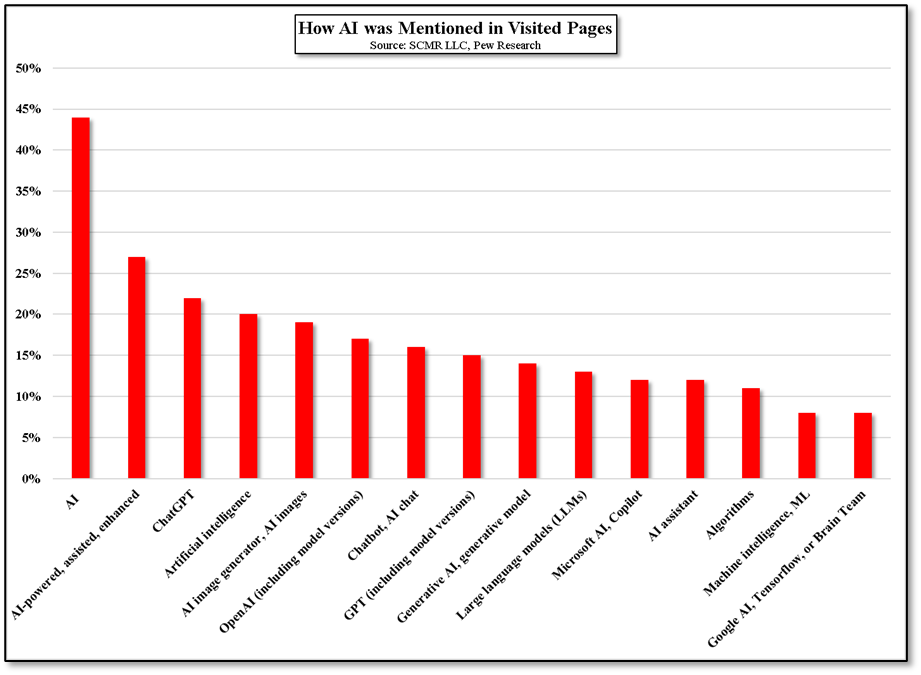
Figure 1 - How AI was Mentioned in Visited Pages -0 Source: SCMR LLC, Pew Research
However, the most interesting data in the survey was not about how interested participants were in AI and related topics but how the AI summaries affected their browsing, a topic we have been focused on, as it has the potential to disrupt the highly concentrated search market. The survey data separated results between participant search pages that had an AI summary and those that did not. [Note that these are all Google (GOOG) searches.]
At the onset, the most telling point was that Google search users are more likely to end their browsing session after visiting a search page with an Ai summary than a page without a summary. According to the survey, this happened on 26% of the pages with an AI summary, compared to 10% of the pages without an AI summary, essentially traditional search pages. This is not what those who advertise on popular websites want to hear but reflects an actual lesser need for detailed information than content producers might imagine. In a typical web search, without an AI summary, the user will click on at least one link to clarify the search results, but as the summary contains bits of information and data from a number of sites, much of what the user was looking for is made available without a next-level visit. While the summary is the essence of the search, it obviates the need for more information in many cases.
The most frequently cited sources in both typical Google searches and Google AI summaries are Wikipedia (non-profit), You Tube (Google), and Reddit (RDDT). They accounted for 15% of the sources listed in AI summaries and 17% of sources in typical searches. The data shows that when examining the first three links of Google summaries and the first page of traditional Google searches, Wikipedia, xxx.gov, and reddit came up more often in summaries than they did in traditional searches. You Tube was more common in traditional searches than in summaries.
At the onset, the most telling point was that Google search users are more likely to end their browsing session after visiting a search page with an Ai summary than a page without a summary. According to the survey, this happened on 26% of the pages with an AI summary, compared to 10% of the pages without an AI summary, essentially traditional search pages. This is not what those who advertise on popular websites want to hear but reflects an actual lesser need for detailed information than content producers might imagine. In a typical web search, without an AI summary, the user will click on at least one link to clarify the search results, but as the summary contains bits of information and data from a number of sites, much of what the user was looking for is made available without a next-level visit. While the summary is the essence of the search, it obviates the need for more information in many cases.
The most frequently cited sources in both typical Google searches and Google AI summaries are Wikipedia (non-profit), You Tube (Google), and Reddit (RDDT). They accounted for 15% of the sources listed in AI summaries and 17% of sources in typical searches. The data shows that when examining the first three links of Google summaries and the first page of traditional Google searches, Wikipedia, xxx.gov, and reddit came up more often in summaries than they did in traditional searches. You Tube was more common in traditional searches than in summaries.

Overall 18% of Google searches produced an AI summary and 88% of those summaries cited three or more sources (Only 1% cited a single source). In passing, the shortest summary produced was only seven words long, while the longest was 369 words, and while that sounds like a less than useful metric, it turns out that longer searches (words) are more likely to produce summaries. Only 8% of one or two word searches generated a summary, while searches with 10 or more words generated a summary 53% of the time. More detail revealed that searches that contain a noun and a verb generate an AI summary 36% of the time while those searches that start with a question word generate a summary 60% of the time.

The data is very helpful in gaining a more realistic understanding of the consumer’s view of AI and a more nuanced look at how the generation of AI summaries is affecting the monetization of search results. As the premier search engine developer, Google has the most to lose, although in the same regard it has the most ‘staying power’, especially in comparison to smaller search engines. But while Google might not feel that what is a small loss of click through’s is meaningful publicly, advertisers are likely more sensitive, since their advertising rates are based on metrics like CTR and conversions, in reality Google is definitely concerned.
Google, at least on a public basis, has indicated a focus on ‘higher quality clicks’, and higher user satisfaction, but on a long-term basis they have to be concerned over any potential for slower growth. Google has one point in its favor and that is that the algorithm that creates the AI search summaries is Google’s own, allowing them to make any modifications they want and that leaves the summaries open to advertising (likely a premium category) and highly visual summaries for commercial queries. It is a hard to balance between improving user click quality and not destroying per click income but also a situation that was inevitable. If Google did not create the summary algorithm and incorporate it in its search results a competitor would have. Now they have the most control over how to find a solution
That said, what the survey shows is that consumers are not nearly as enamored with AI as the tech press would like us to believe, essentially willing to use anything that causes them to have to do less work. If they can get their search answer from a summary and don’t have to wait the 2.5 to 3.2 seconds it takes for the average page to load, they will, especially after few years of becoming used to summaries. If Google can find a comfortable way to monetize summaries they should be able to compensate or even exceed any standard advertising loss, but in the interim it could be a bumpy ride.
Google, at least on a public basis, has indicated a focus on ‘higher quality clicks’, and higher user satisfaction, but on a long-term basis they have to be concerned over any potential for slower growth. Google has one point in its favor and that is that the algorithm that creates the AI search summaries is Google’s own, allowing them to make any modifications they want and that leaves the summaries open to advertising (likely a premium category) and highly visual summaries for commercial queries. It is a hard to balance between improving user click quality and not destroying per click income but also a situation that was inevitable. If Google did not create the summary algorithm and incorporate it in its search results a competitor would have. Now they have the most control over how to find a solution
That said, what the survey shows is that consumers are not nearly as enamored with AI as the tech press would like us to believe, essentially willing to use anything that causes them to have to do less work. If they can get their search answer from a summary and don’t have to wait the 2.5 to 3.2 seconds it takes for the average page to load, they will, especially after few years of becoming used to summaries. If Google can find a comfortable way to monetize summaries they should be able to compensate or even exceed any standard advertising loss, but in the interim it could be a bumpy ride.

 RSS Feed