Earthyness
In response to US export restrictions on semiconductors and semiconductor production equipment, China has its own “Dual-Use” list of items that can be used in everyday items and in weaponry. These items require a governmental review and the issuance of a license before they can be exported from the country, essentially allowing the Chinese government to use them to limit US advanced R&D and undermine the US military and semiconductor development efforts. There are a substantial number of items in the Chinese list that are produced primarily in China, with only a small percentage of total consumption available from sources off the mainland, leaving little chance of the US stockpiling such materials or rapidly replacing newly restricted Chinese materials, and while the US government downplays the potential impact that these restrictions might have on various military projects and industries, even small shortages can slow or halt billion dollar programs and certainly contribute to rapidly rising costs.
Last week China abruptly restricted the export of Indium Phosphide substrates, likely in response to some recent restrictive move by the Trump administration. InP substrates are used in the production of laser diodes, photodetectors, and single-chip combination laser/amplifier/modulators, but most importantly InP is used to produce High Electron Mobility Transistors (HEMT) and a variety of RF and Microwave advanced communication components, along with high efficiency solar cells that are used for space communications. The specific objective is not known but even with a number of suppliers of Indium itself, other than China, InP substrates will become harder to source.
Each addition to China’s list, especially in the rare earth category, puts more pressure on the administration to strike a deal with China, as alternate sources for a number of key materials are small but rarely does the WH indicate that China has any leverage in trade talks. In fact, when it comes to rare earth elements, while the US Geological Survey does not break out individual rare earth consumption and sourcing for the US, on an overall basis , the US imports ~80% of its rare earth consumption each year, with 56% of those elements coming from China. Based on 2022 data, China is the leading supplier of 29 of the 50 most critical minerals and controls 85% of the processing for those minerals.
Last week China abruptly restricted the export of Indium Phosphide substrates, likely in response to some recent restrictive move by the Trump administration. InP substrates are used in the production of laser diodes, photodetectors, and single-chip combination laser/amplifier/modulators, but most importantly InP is used to produce High Electron Mobility Transistors (HEMT) and a variety of RF and Microwave advanced communication components, along with high efficiency solar cells that are used for space communications. The specific objective is not known but even with a number of suppliers of Indium itself, other than China, InP substrates will become harder to source.
Each addition to China’s list, especially in the rare earth category, puts more pressure on the administration to strike a deal with China, as alternate sources for a number of key materials are small but rarely does the WH indicate that China has any leverage in trade talks. In fact, when it comes to rare earth elements, while the US Geological Survey does not break out individual rare earth consumption and sourcing for the US, on an overall basis , the US imports ~80% of its rare earth consumption each year, with 56% of those elements coming from China. Based on 2022 data, China is the leading supplier of 29 of the 50 most critical minerals and controls 85% of the processing for those minerals.
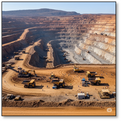
For example:
Among the most critical is Yttrium, an element that the US imports almost 100% of its needs from other countries, 93% of which comes from China. The Department of Defense has identified Yttrium as essential for military applications and indicated that even a 90 day supply interruption could have a significant effect on defense contractors. 42% of yttrium consumption comes from its use in red display phosphors and LEDs, the radioactive Y90 isotope is used to treat cancer (64 day half-life), it is also used as a high-temperature metalogical additive for jet-engines, and as a source (Yttrium-Iron Garnet) in microwave radar systems, making it a very necessary material for both the military and commercial markets.
While Yttrium is an extreme case, there are many other strategic materials where production and refining are dominated by China and despite the 2025 Nation Defense Authorization Act allocation of $1.2 billion for stockpiling rare earths and $350 million for domestic development of rare earth materials, the US has a critical dependency on China for both rare earth minerals and a number of other important materials for both the military and commercial products. Products like semiconductors, TVs, smartphones, and soybeans make the headlines when it comes to trade negotiations between China and the US, but underlying those popular products are many far more critical materials that we believe are also a major part of the negotiations but receive far less publicity because of their sensitive nature.
Among the most critical is Yttrium, an element that the US imports almost 100% of its needs from other countries, 93% of which comes from China. The Department of Defense has identified Yttrium as essential for military applications and indicated that even a 90 day supply interruption could have a significant effect on defense contractors. 42% of yttrium consumption comes from its use in red display phosphors and LEDs, the radioactive Y90 isotope is used to treat cancer (64 day half-life), it is also used as a high-temperature metalogical additive for jet-engines, and as a source (Yttrium-Iron Garnet) in microwave radar systems, making it a very necessary material for both the military and commercial markets.
While Yttrium is an extreme case, there are many other strategic materials where production and refining are dominated by China and despite the 2025 Nation Defense Authorization Act allocation of $1.2 billion for stockpiling rare earths and $350 million for domestic development of rare earth materials, the US has a critical dependency on China for both rare earth minerals and a number of other important materials for both the military and commercial products. Products like semiconductors, TVs, smartphones, and soybeans make the headlines when it comes to trade negotiations between China and the US, but underlying those popular products are many far more critical materials that we believe are also a major part of the negotiations but receive far less publicity because of their sensitive nature.

 RSS Feed