Fun with Data – Prime Day
Shopping holidays are good for the economy, at least the on-line economy, but they have a problem. They always need to grow, or they reflect a slowing economy, a slowing on-line presence, or other factors (high inflation, weak currency, etc.) that impact demand negatively. As few artificially concocted shopping events can sustain positive growth momentum for more than a few years, event planners tend to add additional days to these shopping events to boost ‘total’ sales. When it comes time for y/y comparisons however publicists tend to ‘forget’ to divide the event sales total by the number of days and just point to the absolute total rather than a realistic daily comparison. It is the same thinking as “Still the same $3 a bottle for the last 5 years”, although the bottle now contains 15% less juice.
Prime Day, Amazon’s (AMZN) self-proclaimed shopping holiday, tried to pass off a similar dodge this year, pointing to the fact that Prime day sales were $24.1b, and referenced 2024’s $14.2b as a comparison, a spectacular improvement that placed Prime Day 2025 ahead of Black Friday and Cyber Monday. What they did not mention was that Prime Day this year was a 4 day event, while it was a 2 day event last year, and the comparisons against Black Friday and cyber Monday were both against those as single day totals. As Amazon does not seem to be releasing event GMV this year we have to rely on outside figures which vary considerably.
Adobe (ADBE) Analytics says the first day sales were $7.9b, which would indicate a ~30% increase y/y, others say the first day was down over 40%, while still others say the 4-day total was up 4.9% y/y include the 2 days after the holiday last year for comparison, even though they were not part of the official Prime Day last year. It seems that Prime Day was a bit better this year, but wouldn’t Amazon be happy to publicize that data if it was real? We can’t seem to get a verifiable answer….
That said, at least we have some data that gives a picture of customer web visits before and during the event that give some understanding of how interested consumers were in checking out deals. Based on the data we can make the following assumptions (reminder – this data is for web visits, not sales):
We break the data into four units:
We understand that much of the momentum behind such shopping events is generated through advertising, and that it is inevitable that at some point that momentum wanes, but at the same time obfuscating comparative information does not seem to do much other than wear down consumers. China continues to face this same problem with their shopping holidays that continue to be extended each year, and even more concerning for the current consumer subsidy program that has been helping to sustain the Chinese retail economy. Eventually consumers become inured to the ‘glorious’, ’incredible’, or ‘spectacular’ results that are publicized each year. Perhaps it might be better to end the program and try a new one after a few years to freshen up the event. We know the idea is to fill in the retail slow season with something that can stimulate sales, but at least, try to freshen it up with a new name…
Prime Day, Amazon’s (AMZN) self-proclaimed shopping holiday, tried to pass off a similar dodge this year, pointing to the fact that Prime day sales were $24.1b, and referenced 2024’s $14.2b as a comparison, a spectacular improvement that placed Prime Day 2025 ahead of Black Friday and Cyber Monday. What they did not mention was that Prime Day this year was a 4 day event, while it was a 2 day event last year, and the comparisons against Black Friday and cyber Monday were both against those as single day totals. As Amazon does not seem to be releasing event GMV this year we have to rely on outside figures which vary considerably.
Adobe (ADBE) Analytics says the first day sales were $7.9b, which would indicate a ~30% increase y/y, others say the first day was down over 40%, while still others say the 4-day total was up 4.9% y/y include the 2 days after the holiday last year for comparison, even though they were not part of the official Prime Day last year. It seems that Prime Day was a bit better this year, but wouldn’t Amazon be happy to publicize that data if it was real? We can’t seem to get a verifiable answer….
That said, at least we have some data that gives a picture of customer web visits before and during the event that give some understanding of how interested consumers were in checking out deals. Based on the data we can make the following assumptions (reminder – this data is for web visits, not sales):
We break the data into four units:
- The 5 days starting a week before the event (Pre-5-day)
- The two days directly before the event (2-day-warm-up)
- The 4 days during the event (4-day event)
- The peak day during the event
- The Pre-5-day average number of web visits was 75.7786m
- The 2-day-warm-up saw an average of 82.8165m visits, 9.3% higher that the previous 5 days
- The 4-day event average was 98.74m visits, 30.3% higher than the Pre-5-day average.
- The peak day (102.96m visits), which was not the first day this year, was 35.9% higher than the Pre-5-day average.
We understand that much of the momentum behind such shopping events is generated through advertising, and that it is inevitable that at some point that momentum wanes, but at the same time obfuscating comparative information does not seem to do much other than wear down consumers. China continues to face this same problem with their shopping holidays that continue to be extended each year, and even more concerning for the current consumer subsidy program that has been helping to sustain the Chinese retail economy. Eventually consumers become inured to the ‘glorious’, ’incredible’, or ‘spectacular’ results that are publicized each year. Perhaps it might be better to end the program and try a new one after a few years to freshen up the event. We know the idea is to fill in the retail slow season with something that can stimulate sales, but at least, try to freshen it up with a new name…
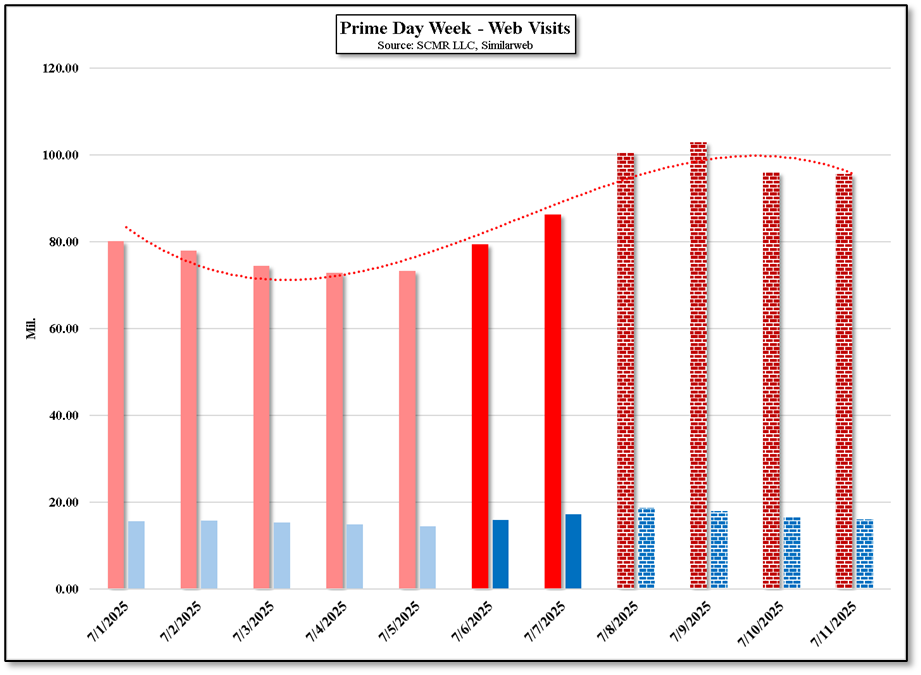
Figure 1 - Prime Day Week - Web Visits - Source SCMR LLC, Similarweb
 RSS Feed