Fun with Data – Tablet Refresher
Laptops are the captain of the football team brother. Desktop PCs and monitors are the smart brother, and tablets are the quiet brother who sketches scenes from Tolkien novels during class. You don’t hear much from the quiet brother and you don’t hear much from the tablet market, other than an occasional program announcement to supply every kid in a particular town, city, state or country with such a device, but for those brands that dominate the tablet space, they are still a key product category. The problem is however that tablets don’t really have a secure place in the CE hierarchy. They are not as large or powerful as laptops or desktops and while they formerly offered an ersatz smartphone-like format on a larger screen, foldable smartphones are encroaching on the tablet space with a more powerful and larger, although more expensive, devices.
Tablets were originally touted as workplace devices that allowed full pages of data or schematics to be shown, rather than scrolling endlessly on a smartphone, but laptops have become lighter and thinner and continue to encroach on the tablet space. Tablets have now become media and entertainment platforms, allowing users to view streaming services on a screen size that is large enough to show detail, or play games without missing objects because of their size. They still have a place in the content creation space where spur-of-the-moment sketches with a stylus rule, and they are a viable on-the-go source for video conferencing, but the education market is the real driver for tablet demand.
Apple (AAPL) is the obvious leader in the tablet space with a 5 year share average of 36.8%, followed by Samsung (005930.KS) with a 5-year share average of 18.8%. After that it is Amazon (AMZN), Lenovo (992.HK), Huawei (pvt), and Xiaomi (1810.HK), with shares between ~ 6% and 8% each, with the ‘other’ category making up most of the difference. There are many others that register in the top 10 occasionally, like Microsoft (MSFT), LG (066570.KS), and ASUS (2357.TT), but they tend to be out of the top 5 in most quarters.
Tablet selection for consumers is relatively simple as the feature set is narrow, with major choices whether the device will connect to cell, Wi-Fi, Bluetooth or a combination, what size screen you want (typically ~8” to 14.6”), how much memory and storage you need, and what operating system you want. The OS is the only tricky choice, with Android, Windows, iOS, Chrome, and Fire offerings as this can determine the potential applications that can be used on the device. You cannot directly run Windows™ applications in an Android environment but there are ways to get around that issue if you have some technical know-how, and the same is true for iOS (or iPadOS), so some thought about what the tablet is going to be used for is necessary for that decision, and then there is price.
Tablet prices have a wide range. There is a market for 7” young child oriented tablets that sell for under $100 while the top end of the range is typically Apple’s iPad Pro line that peaks at ~$2,350, so it is difficult to give an average, but we expect $400 to $600 to be the average range for generic laptop pricing. Large deployments, like Japan’s GIGA School Program, which provided over 7 million tablets to students across the country, set a maximum device budget of ¥50,000 (currently $338 US, although it was closer to $500 when the program began) which gives some idea of the price range of tablets for the educational market, with content creation tablets toward the high-end of pricing.
The problem is however, less price oriented and more demand oriented. Figure 1 shows tablet shipments (blue) against tablet panel shipments (red). In the early days of tablet production, the tablet panel market was very tight, and price was stable and robust. COVID changed that perspective as tablet panel production expanded along with demand, however as the pandemic wound down, tablet panel production remained high and pricing suffered, and as can be seen below, tablet panel production remains high, outstripping demand, keeping a lid of tablet panel pricing. This leaves us to wonder why panel producers are still allocating as much production capacity to tablets, and that shifts back to Apple and its three main tablet suppliers, Samsung Display (pvt), LG Display (LPL) and BOE (200725.CH). Apple demands high quality and performance from its displays, and as such panel producers can extract a premium for same. With such a large share Apple keeps the tablet market alive. The rest of the market is high-volume low margin more generic tablet panel production for smaller share brands, and we believe that profitability hovers around break-even to a slight profit. As long as demand does not weaken further, we expect tablets to continue to survive as a CE category, but with foldables, smartphones, and laptops edging deeper into tablet territory, we wonder if we are looking at a sunrise or sunset scenario.
Tablets were originally touted as workplace devices that allowed full pages of data or schematics to be shown, rather than scrolling endlessly on a smartphone, but laptops have become lighter and thinner and continue to encroach on the tablet space. Tablets have now become media and entertainment platforms, allowing users to view streaming services on a screen size that is large enough to show detail, or play games without missing objects because of their size. They still have a place in the content creation space where spur-of-the-moment sketches with a stylus rule, and they are a viable on-the-go source for video conferencing, but the education market is the real driver for tablet demand.
Apple (AAPL) is the obvious leader in the tablet space with a 5 year share average of 36.8%, followed by Samsung (005930.KS) with a 5-year share average of 18.8%. After that it is Amazon (AMZN), Lenovo (992.HK), Huawei (pvt), and Xiaomi (1810.HK), with shares between ~ 6% and 8% each, with the ‘other’ category making up most of the difference. There are many others that register in the top 10 occasionally, like Microsoft (MSFT), LG (066570.KS), and ASUS (2357.TT), but they tend to be out of the top 5 in most quarters.
Tablet selection for consumers is relatively simple as the feature set is narrow, with major choices whether the device will connect to cell, Wi-Fi, Bluetooth or a combination, what size screen you want (typically ~8” to 14.6”), how much memory and storage you need, and what operating system you want. The OS is the only tricky choice, with Android, Windows, iOS, Chrome, and Fire offerings as this can determine the potential applications that can be used on the device. You cannot directly run Windows™ applications in an Android environment but there are ways to get around that issue if you have some technical know-how, and the same is true for iOS (or iPadOS), so some thought about what the tablet is going to be used for is necessary for that decision, and then there is price.
Tablet prices have a wide range. There is a market for 7” young child oriented tablets that sell for under $100 while the top end of the range is typically Apple’s iPad Pro line that peaks at ~$2,350, so it is difficult to give an average, but we expect $400 to $600 to be the average range for generic laptop pricing. Large deployments, like Japan’s GIGA School Program, which provided over 7 million tablets to students across the country, set a maximum device budget of ¥50,000 (currently $338 US, although it was closer to $500 when the program began) which gives some idea of the price range of tablets for the educational market, with content creation tablets toward the high-end of pricing.
The problem is however, less price oriented and more demand oriented. Figure 1 shows tablet shipments (blue) against tablet panel shipments (red). In the early days of tablet production, the tablet panel market was very tight, and price was stable and robust. COVID changed that perspective as tablet panel production expanded along with demand, however as the pandemic wound down, tablet panel production remained high and pricing suffered, and as can be seen below, tablet panel production remains high, outstripping demand, keeping a lid of tablet panel pricing. This leaves us to wonder why panel producers are still allocating as much production capacity to tablets, and that shifts back to Apple and its three main tablet suppliers, Samsung Display (pvt), LG Display (LPL) and BOE (200725.CH). Apple demands high quality and performance from its displays, and as such panel producers can extract a premium for same. With such a large share Apple keeps the tablet market alive. The rest of the market is high-volume low margin more generic tablet panel production for smaller share brands, and we believe that profitability hovers around break-even to a slight profit. As long as demand does not weaken further, we expect tablets to continue to survive as a CE category, but with foldables, smartphones, and laptops edging deeper into tablet territory, we wonder if we are looking at a sunrise or sunset scenario.
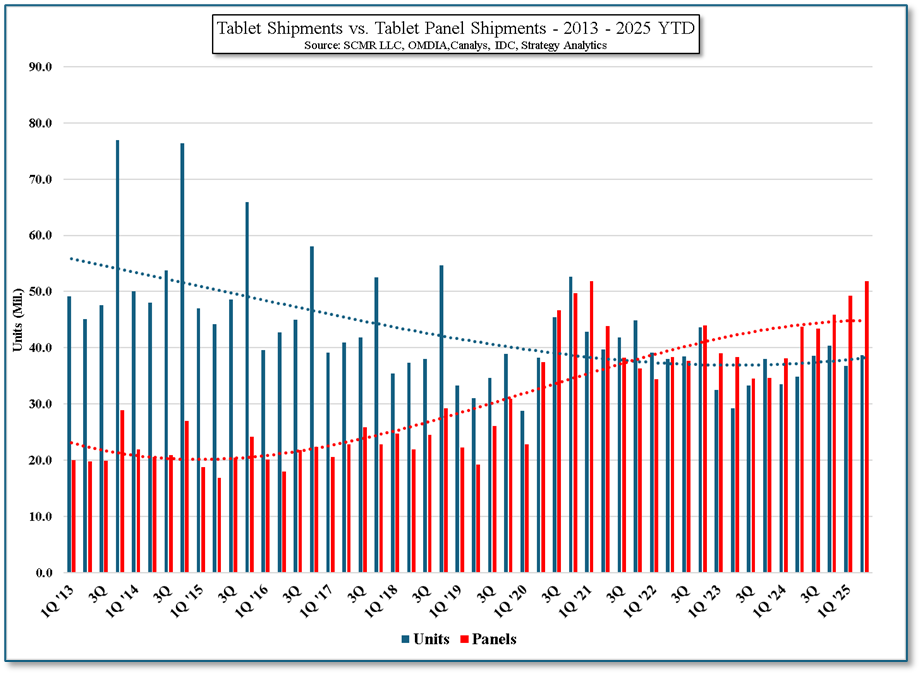
Figure 1 - Tablet Shipments vs. Tablet Panel Shipments - 2013 - 2025 YTD - Source: SCMR LLC, OMDIA, Canalys, IDC, Strategy Analytics

 RSS Feed