iPhone Pro Max – Hardware only
Apple (AAPL) announced a series of new products yesterday, among them the new models of the iPhone (iPhone 17 series). We take a look at the differences between the iPhone 16 Pro Max and the iPhone 17 Pro Max from a hardware perspective, with the understanding that this look does not include many of the internal components that would be the subject of a teardown. We do this from the perspective of the average consumer who sees look-and-feel along with major visible components as their guide to how different the new device is compared to last year’s model. We only list those items that have changed and highlight the important ones:
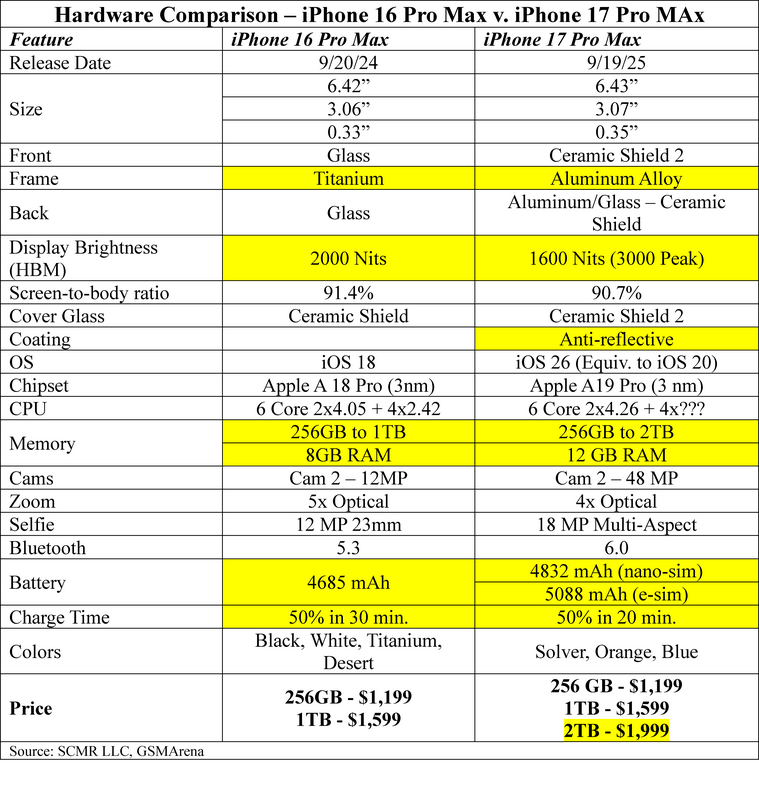
We note the following:
- Typical display brightness for both models is 1,000 nits. The iPhone 16 Pro Max display was able to sustain a 2,000 nit display in high brightness mode, but it seems that it required considerable power which could lead to issues like throttling. The iPhone 17 Pro Max has a lower sustainable HBM level, likely to avoid rapid battery drain or other issues, but can reach 3,000 nits for very short period (peak is measured in milliseconds). Most consumers will care about standard mode and HBM when in sunlight, so peak is almost irrelevant.
- The iPhone 17 Pro Max is the first iPhone to have a dedicated anti-reflective coating, a point for competition among high-end phones.
- While the inclusion of a 2TB memory option for the iPhone 17 Pro Max is not surprising (a $400 option) it is an option that will become more commonplace as memory prices decline, and on-board AI requires dedicated memory. A medium size 7 billion parameter model requires at least 14 GB of RAM, although newer phones that are optimized for AI can work on less, but large tasks need larger memory, as many model core parameters must be loaded into phone RAM when the model is first invoked in order to operate. They can stay in cached mode (lower memory use) when not in use while other applications are running, but if they are ended or the phone is restarted, they must be reloaded again. This is very similar to the way some applications run in the background while the phone is doing other things.
- The larger battery in the iPhone 17 Pro Max is a function of space. Removing the sim card and replacing it with an electronic sim (e-sim or nano-sim) frees up space. In earlier iPhones (iPhone 14 on) the empty space was either filled with a plastic spacer, or the interior was redesigned. In the iPhone 17 Pro Max, Apple used the additional space to increase the capacity of the battery. We believe the charging time improvement is a big plus for consumers.

 RSS Feed