Patience
Buying a TV is a chore. TV brands list dozens of features many of which are esoteric and undecipherable for the average buyer and having sold TVs and stereos many years ago, one learns that there are many tricks retailers use to ‘enhance’ the look of in-store TV demos. Salespeople range from overly technical (an 82 year-old grandmother, replacing a 24” CRT TV does not need to know about the quality of the upscaler) to overly folksy (My cousin bought this one and his wife loves it), with fiscal influences always in the back of the salesperson’s mind. Even in stores where salespeople do not work on commission, memos about certain brands with ‘more attractive margins’ tend to influence recommendations and don’t always jive with what might be best for the customer. We are not saying that salespersons are misleading, but bias is not easily controlled and can be a silent influencer.
Doing research on TVs for the average consumer usually consists of finding one or two sites that list ‘the best of…’ and jotting down a few names and model numbers, or (hopefully not) reading product reviews on Yelp (YELP) or Amazon (AMZN). Most disconcerting to us are the TV ads that point to ‘Huge discounts’ or ‘big price drop’ that are meant to give the consumer the impression that they need to buy right away or they will lose those discounts. The common practice is to always state the current ‘discounted’ price against the MSRP (Manufacturers Suggested Retail Price). This tends to be the price point of the model’s initial release, which in most cases is the highest price the TV will ever see, so a ‘30% price drop’ rarely means a drop from wherever the set was priced most recently, but more likely a 30% drop from the MSRP. Technically, despite how misleading it might be, this 30% discount could put the set at a higher price than its previous price point but it is still considered legitimate advertising (read the small print).
All of this makes one wonder how much timing really matters when buying a TV, as it seems many influences can move prices up and down in an almost random pattern, yet nothing can be further from the truth. TV pricing has a very specific yearly trajectory and pattern, which consumers should understand in order to make the ideal TV purchase. Here are a few points to remember:
Doing research on TVs for the average consumer usually consists of finding one or two sites that list ‘the best of…’ and jotting down a few names and model numbers, or (hopefully not) reading product reviews on Yelp (YELP) or Amazon (AMZN). Most disconcerting to us are the TV ads that point to ‘Huge discounts’ or ‘big price drop’ that are meant to give the consumer the impression that they need to buy right away or they will lose those discounts. The common practice is to always state the current ‘discounted’ price against the MSRP (Manufacturers Suggested Retail Price). This tends to be the price point of the model’s initial release, which in most cases is the highest price the TV will ever see, so a ‘30% price drop’ rarely means a drop from wherever the set was priced most recently, but more likely a 30% drop from the MSRP. Technically, despite how misleading it might be, this 30% discount could put the set at a higher price than its previous price point but it is still considered legitimate advertising (read the small print).
All of this makes one wonder how much timing really matters when buying a TV, as it seems many influences can move prices up and down in an almost random pattern, yet nothing can be further from the truth. TV pricing has a very specific yearly trajectory and pattern, which consumers should understand in order to make the ideal TV purchase. Here are a few points to remember:
- Don’t buy on product release
- New TV models are typically released in 2Q, which means last year’s models tend to be the most attractively priced in 1Q
- Holidays are your friends when buying a TV
- Short-term discounts tend to be less important than the time of year
- Lowest price points for TVs (Premium) occur between day 300 (~October 28) and day 330 (November 26).
- TV set prices can go up quickly in December
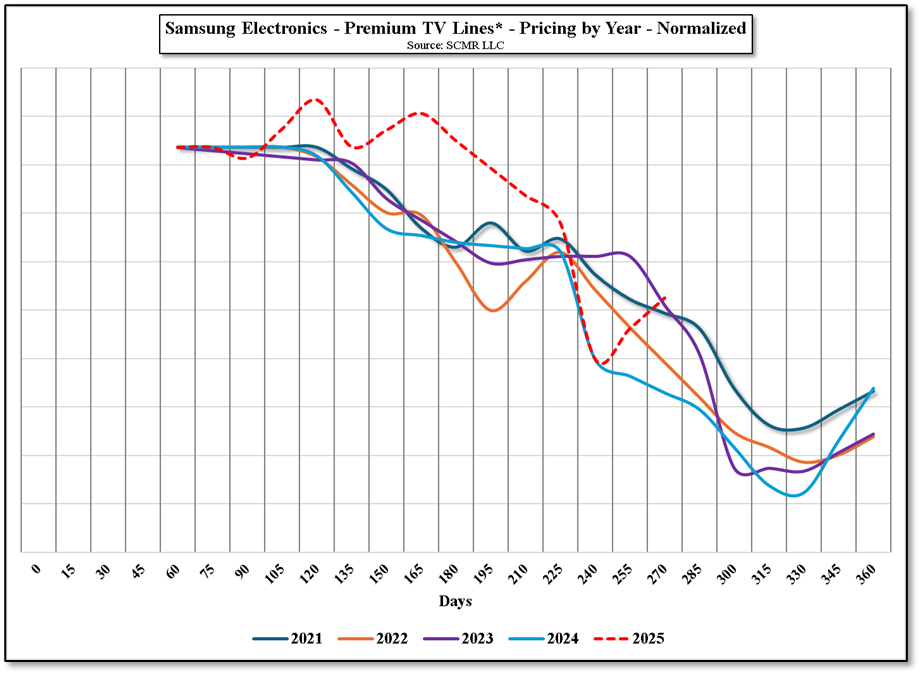
Note: In order to compensate for new and deleted models and feature changes we bring each year’s starting MSRP to a single point. This normalization tracks throughout the year and allows for a better comparison as to how line price changes are occurring throughout the year and how they compare to previous years. Again, this data is for Samsung’s Mini-LED/QD, QD only lines and does not include OLED. OLED data is available on request.
While the data is helpful to consumers, it is also helpful to inventors who own public panel producer and display infrastructure investments, however we note that panel producer performance is greatly influenced by the build cycle rather than the buy cycle, with each product category having specific periods during the year as to when new products enter production and inventories are being built for sale points during the remainder of the year.
While the data is helpful to consumers, it is also helpful to inventors who own public panel producer and display infrastructure investments, however we note that panel producer performance is greatly influenced by the build cycle rather than the buy cycle, with each product category having specific periods during the year as to when new products enter production and inventories are being built for sale points during the remainder of the year.
 RSS Feed