Perceived Value
Ai is revolutionizing the world, and many see it as an invention that rivals fire in terms of its long-tern effect on society. But there is another, slightly less seismic and certainly a bit less profound perception of Ai, it’s use in advertising and product development. We are not talking about how AI might be changing the way advertising agencies produce copy, or how the average consumer receives ads. We mean the concept held by many that almost every product would benefit from AI and that it should be included in almost everything we have contact with in our daily lives. This seems to have become a common theme across almost all product categories with “AI” emblazoned across product literature and “Machine Learning” a common theme in descriptive text, but what is AI actually doing in products and is something worth paying for or just a gimmick?
Oral-B, part of Procter & Gamble (PG) household consumables business model, sells toothbrushes, toothpaste, dental floss and mouthwash. Oral-B manual toothbrushes sell for a little as $0.99 while the Oral-B IO series 10 rechargeable Electric Toothbrush (AI) sells for ~$400. Tooth care is important, as we get one set of teeth that are supposed to last for lifetime, but do we need an AI toothbrush? This electronic marvel has a broad feature set that outshines your ‘generic’ electronic (non-AI) toothbrush by doing the following:
Here's one that gets more positive press, the Ai thermostat. Manufacturers tout using an AI (not just ‘smart’, but ‘AI’) thermostat will generate10% to 12% savings on heating bills and up to 15% on A/C, using a $900/year HVAC base. Similar to the toothbrush scenario, there are two alternatives to the AI thermostat, the first being an old style thermostat that you set to a particular temperature and it maintains that temperature forever. The other alternative is a digital thermostat that allows the user to program temperature settings based on the time of day and the day of the week. The Ai thermostat offers the following features:
There is some nuance here, as utilities tend to classify thermostats that are not AI but can be programmed via Wi-Fi as ‘smart devices, giving substantial rebates to those devices, so AI is not necessary to qualify but wi-Fi programmability is. The average rebate in our neck of the woods is $85, which can bring down the cost of a Wi-Fi programmable thermostat to almost nothing, although our utility reserves the right to change the setting on your thermostat during the summer up to 10 times for a maximum of 4 hours to reduce stress on the grid. All in, AI thermostats are likely able to save a user ~$100/year in ideal circumstances, against a non-programmable or poorly programmed thermostat. A well programmed thermostat for a user with a steady routine would likely save a similar amount.
One last one, and one a bit more controversial. AI TVs. AI TVs are peddled as having the ability to analyze content, down to the pixel level, and dynamically enhance content and they do just that. After training on thousands of images, they learn to break down video on a frame-by-frame basis and isolate objects, backgrounds, faces, text, and a variety of other objects, and find ways to enhance each frame. This is in contrast to non-AI video processors that are based on non-adaptive algorithms that do not break down frames into component parts but apply a ‘fix’ to each frame based on its overall characteristics..
This comes in handy when the set is upscaling, taking low resolution content and expanding it to fit a high-resolution display. The object is to fill in those ‘new’ pixels that were created and AI systems can refer back to their high-res training data to see what those missing pixels might look like. It is also used to insert or remove frames to smooth motion by predicting how moving objects can best be displayed.
We don’t disagree that AI is very adept at creating ‘fill in the gap’ pixels, better than the standard method of interpolating neighboring pixel information, but there are two problems associated with AI video processing. First, while TV engineers have display tools that go far beyond human perception, the average person is not going to see much of a change between an AI processor and a non-AI processor. In some circumstances it might be noticeable, but most likely not on a day-to-day basis. Second, there is an AI premium. Depending on the price tier, the cost of adding an AI video processor can be anywhere from ~$300 to $1,000+ vs. a non-AI, but very capable processor. Mid-tier sets would see a lower cost spread, and low-end TVs would not be AI enabled in most cases. We know we will get some feedback from some of our readers and clients who are close to or in the TV industry, but we try to look at AI from a user’s standpoint, and we stick to our guns.
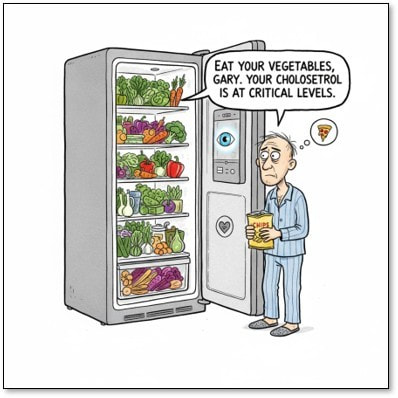
There are many more AI enhanced products that should either not be labeled AI or gain little or nothing from its inclusion, other than a premium price, and the 2026 Consumer Electronics show in early January will abound with ‘AI pogo-sticks’, ‘AI Hair Dryers’, and the ever popular ‘AI refrigerator’. There will always be some consumers who will opt for such madness, but the average Joe does not need another device nagging him to eat his vegetables or instructing her to let the hair dryer cool before using again, and they certainly don’t want the cost of AI to be added to those products unless it can actually create value, rather than the perceived value that brands tend to emphasize.
Oral-B, part of Procter & Gamble (PG) household consumables business model, sells toothbrushes, toothpaste, dental floss and mouthwash. Oral-B manual toothbrushes sell for a little as $0.99 while the Oral-B IO series 10 rechargeable Electric Toothbrush (AI) sells for ~$400. Tooth care is important, as we get one set of teeth that are supposed to last for lifetime, but do we need an AI toothbrush? This electronic marvel has a broad feature set that outshines your ‘generic’ electronic (non-AI) toothbrush by doing the following:
- The toothbrush can track 16 (!) zones in your mouth to ensure complete brushing coverage. The standard model has a 30 second timer that tells you to move to the next (of 4) zones.
- Via the Oral-B app or the iO “Sense Charger”, the toothbrush will show you a live map of your mouth, highlighting missed spots as you brush. The standard model forces you to rely on your own sense of coverage.
- It has a pressure sensor and three indicator lights that specifies how much pressure is being used when brushing and slows down if you are brushing too hard. The standard model only has a red light to indicate when you are brushing too hard.
- It has 7 cleaning modes (Daily Clean, Sensitive, Super Sensitive, Intense Clean, Whitening, Gum Care, and Tongue Clean). The standard model can have anywhere from 1 cleaning mode to 5.
- The AI model has a magnetic drive (nothing to do with AI) that allows the oscillating motion to be combined with micro-vibrations. The standard model relies on pulsations.
Here's one that gets more positive press, the Ai thermostat. Manufacturers tout using an AI (not just ‘smart’, but ‘AI’) thermostat will generate10% to 12% savings on heating bills and up to 15% on A/C, using a $900/year HVAC base. Similar to the toothbrush scenario, there are two alternatives to the AI thermostat, the first being an old style thermostat that you set to a particular temperature and it maintains that temperature forever. The other alternative is a digital thermostat that allows the user to program temperature settings based on the time of day and the day of the week. The Ai thermostat offers the following features:
- Algorithms that learn your routines (home, away, day, night, etc.) built on occupancy sensors or geofencing based from your smartphone’s location and movements (GPS). Digital thermostats require the user to program in scheduled temperature changes, and generic thermostats stay at the same temperature regardless of the time or day.
- The AI system measures how long it takes to heat or cool the home and uses that to anticipate the time it takes to bring the home to the desired temperature. Digital thermostats are triggered by time and temperature, so again they rely on the user having set those parameters.
- AI thermostats use temperature averaging. Wireless sensors are placed in various rooms, and the system adjusts the overall temperature based on an average of all of the rooms. Unless the system is able to be adjusted on a room-by-room basis (rarely unless using mini-splits) averaging would make little difference for rooms that are north facing or South facing. Digital thermostats do not make any such calculations and heat each room based on the temperature at the thermostat point, making placement important.
- The one part of AI thermostats that makes the most sense is the ability to use sensors to note modifications to the normal schedule. Should one take a half-day and arrive home at 3PM instead of 6PM, the system will sense that someone is in the house and adjust the temperature by pulling forward the typical pattern. Should the same scenario occur with the digital thermostat, one would have to manually raise the temperature.
There is some nuance here, as utilities tend to classify thermostats that are not AI but can be programmed via Wi-Fi as ‘smart devices, giving substantial rebates to those devices, so AI is not necessary to qualify but wi-Fi programmability is. The average rebate in our neck of the woods is $85, which can bring down the cost of a Wi-Fi programmable thermostat to almost nothing, although our utility reserves the right to change the setting on your thermostat during the summer up to 10 times for a maximum of 4 hours to reduce stress on the grid. All in, AI thermostats are likely able to save a user ~$100/year in ideal circumstances, against a non-programmable or poorly programmed thermostat. A well programmed thermostat for a user with a steady routine would likely save a similar amount.
One last one, and one a bit more controversial. AI TVs. AI TVs are peddled as having the ability to analyze content, down to the pixel level, and dynamically enhance content and they do just that. After training on thousands of images, they learn to break down video on a frame-by-frame basis and isolate objects, backgrounds, faces, text, and a variety of other objects, and find ways to enhance each frame. This is in contrast to non-AI video processors that are based on non-adaptive algorithms that do not break down frames into component parts but apply a ‘fix’ to each frame based on its overall characteristics..
This comes in handy when the set is upscaling, taking low resolution content and expanding it to fit a high-resolution display. The object is to fill in those ‘new’ pixels that were created and AI systems can refer back to their high-res training data to see what those missing pixels might look like. It is also used to insert or remove frames to smooth motion by predicting how moving objects can best be displayed.
We don’t disagree that AI is very adept at creating ‘fill in the gap’ pixels, better than the standard method of interpolating neighboring pixel information, but there are two problems associated with AI video processing. First, while TV engineers have display tools that go far beyond human perception, the average person is not going to see much of a change between an AI processor and a non-AI processor. In some circumstances it might be noticeable, but most likely not on a day-to-day basis. Second, there is an AI premium. Depending on the price tier, the cost of adding an AI video processor can be anywhere from ~$300 to $1,000+ vs. a non-AI, but very capable processor. Mid-tier sets would see a lower cost spread, and low-end TVs would not be AI enabled in most cases. We know we will get some feedback from some of our readers and clients who are close to or in the TV industry, but we try to look at AI from a user’s standpoint, and we stick to our guns.
There are many more AI enhanced products that should either not be labeled AI or gain little or nothing from its inclusion, other than a premium price, and the 2026 Consumer Electronics show in early January will abound with ‘AI pogo-sticks’, ‘AI Hair Dryers’, and the ever popular ‘AI refrigerator’. There will always be some consumers who will opt for such madness, but the average Joe does not need another device nagging him to eat his vegetables or instructing her to let the hair dryer cool before using again, and they certainly don’t want the cost of AI to be added to those products unless it can actually create value, rather than the perceived value that brands tend to emphasize.
 RSS Feed