Pile Up

On August 29, the US ended it De Minimis package exemption. Most recently parcels bound for the US with a stated value of $800 or less (raised from $200 in 2016) were exempted from typical import duties and taxes, creating a massive market for foreign retailers who specialized in low-priced items that were shipped directly from the producer to the purchaser. China and Hong Kong lost their de minimis status in early May, while the rest of the world awaited the broad brush elimination last month. Since then 67 countries have restricted or banned accepting packages bound for the US, with most stating that they need time to understand and implement current customs and tax regulations that now apply.
Chinese retailers, like Temu (PDD) & Shein (pvt) have made the US market a priority over the last few years as the unusually high package threshold makes direct shipping lucrative, shown by the increase in DM packages entering the US increasing from 411m in 2018 to 1.36b last year. TEMU alone saw its GMV increase 239% between 2023 and 2024 to 47.5B under the previous rules, and as the table below shows, the US was by far the dominant source of that revenue.
Chinese retailers, like Temu (PDD) & Shein (pvt) have made the US market a priority over the last few years as the unusually high package threshold makes direct shipping lucrative, shown by the increase in DM packages entering the US increasing from 411m in 2018 to 1.36b last year. TEMU alone saw its GMV increase 239% between 2023 and 2024 to 47.5B under the previous rules, and as the table below shows, the US was by far the dominant source of that revenue.

Now that the exemption has been eliminated countries have responded, many suspending all goods and documents from shipment to the US. China has responded with shippers bringing in goods via container, rather than paying the higher per package cost, and Hong Kong Post remains documents only, forcing goods to use more expensive private carriers. On a general basis, according to the Universal Postal Union, international postal traffic to the US has declined by 81% since the de minimis exemption was removed, with 88 postal services reporting the suspension of all or some services to the US. While document shipments have been penalized less, the shift to private carriers is adding cost to consumers who are now responsible for paying the fees on direct ship packages, while the higher shipping costs are hurting small businesses. Larger retailers based in the US that have a large number of international 3rd party sellers are also under pressure as the number of sellers on those platforms is decreasing.

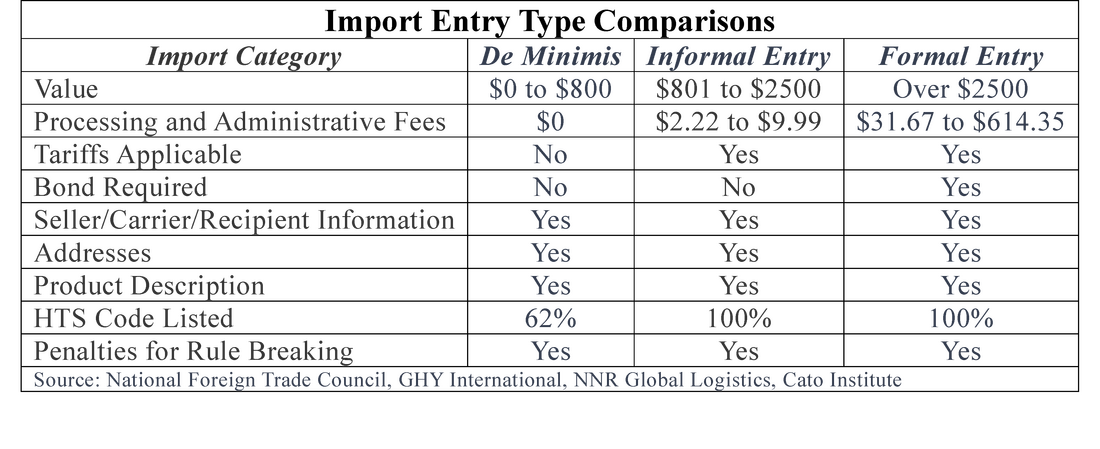
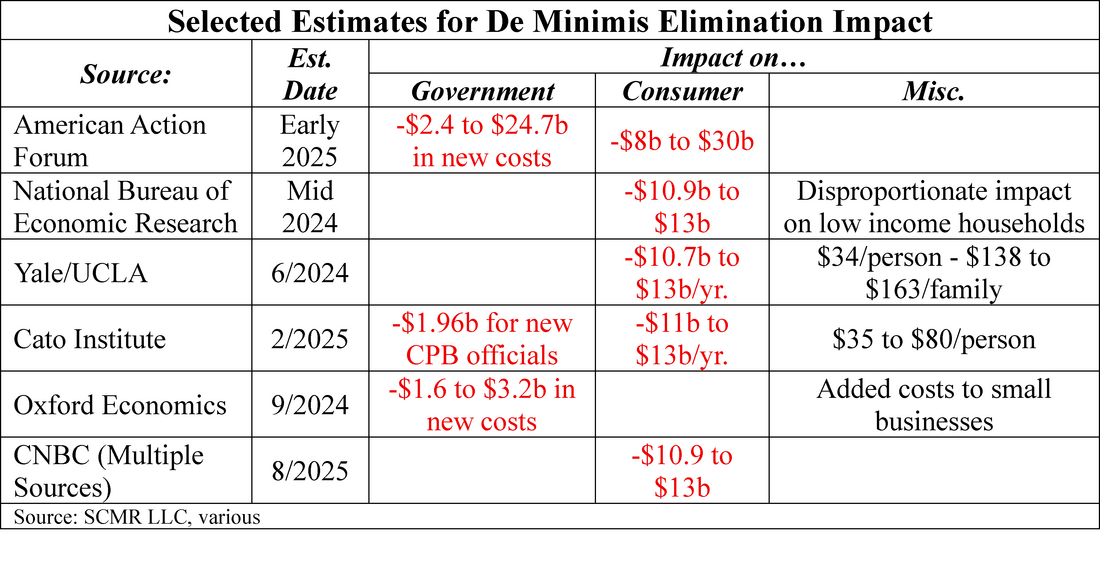
The elimination of the de minimis exemption is another ‘big stick’ approach used by the current administration to force other countries to pay ‘their fair share’ of customs’ fees and taxes, yet the income to the government from those fees does little to help consumers and businesses defray higher costs. That said, it is quite difficult to estimate the true impact of this change to the government, consumers, and businesses, and the estimates we have seen vary considerably and for good reason. Estimating the number of packages expected to be processed this year will depend on how long the countries in the table above continue their restrictions on US package shipments. Now, each package, regardless of value must be evaluated as to its HTS (Harmonized Tariff Schedule) code, based on the contents, and the appropriate country and product tariff applied. The code is the responsibility of the sender, whether a company or an individual, and many country postal systems don’t have the resources to collect and process that information, hence the many suspensions. But the key fact is that the total cost of packages goes from $0 to the total of the processing & administration fee, the tariff for that HTS code (flat fee or ‘ad valorem’) which can be both a country tariff and a reciprocal tariff, and a bond (packages over $2,500).
The credibility of de minimis impact estimates are also biased toward the negative, with most of the calculations focused on the cost to consumers and businesses, while far less focus is paid to the additional income and costs that the government will face. The White House has focused on national security benefits and the revenue-generation with little mention of the cost, while Homeland Security and Customs are singularly focused on that same security aspect. The estimates for new revenue generation from the White House and some US industry groups go as high as $10b/year but again use the security aspect as a proxy for offsetting any new costs. There have been few, if any, legitimate studies that did not predict a negative number for at least the first year in terms of the government P/L, and almost all predicted a negative impact for both consumers and businesses, particularly small businesses.
While the small package market seems minor compared to the broad tariff market, it was (pre-change) headed for over 1.5 billion pieces this year and the status quo of the de minimis market was counted on by both shippers and customs administration. That has been altered, with many countries trying to figure out ways to manage the change. Heading into the holiday season, this global disorganization will cause chaos and add to the cost of purchases this year unless things move quickly over the next month or so, which we do not believe will be the case.
Sidebar – Conversations with a number of small business owners also pointed to the fact that many purchase parts and supplies from overseas suppliers and in order to save cost, those supplies are shipped in small quantities on a quarterly or monthly basis. With that benefit no longer available, small business owners will pay more for those parts and supplies and are likely to increase the size and reduce the frequency of each order, adding to short-term volatility.
 RSS Feed