Slippery Slope
Everybody wants AI and AI model builders are happy to give everybody new and better models on a regular basis, but the question that AIs cannot answer is how many people are willing to pay for AI? At this stage in the AI cycle, businesses are more afraid not to have AI visibly attached to some part of their business than to pay for it and not get comparable benefits, but consumers are different and recent surveys seem to indicate that the subscription conversion rate is very similar to other consumer electronics subscription models, with ‘intent’ surveys as high as 10% and actual conversions between 3% and 5% depending on the model and type of fee offered.
Alas, conversion rates garnered by streaming services, which can run as high as 93% depending on content, are a dream for AI service providers and Gen Z subscribers, who one might assume would sign up to anything ‘AI’ seem to come in with conversion rates between 16% and 18%. But even ChatGPT, with the highest conversion rate among major AI providers, only generates ~5% fee-based conversions.
It is hard to translate conversion rates into sales and even harder to model ongoing costs as models evolve, but a recent occurrence does shed some light on how free to pay conversions are headed and it is not quite as positive as model builders might have hoped. Here’s what happened:
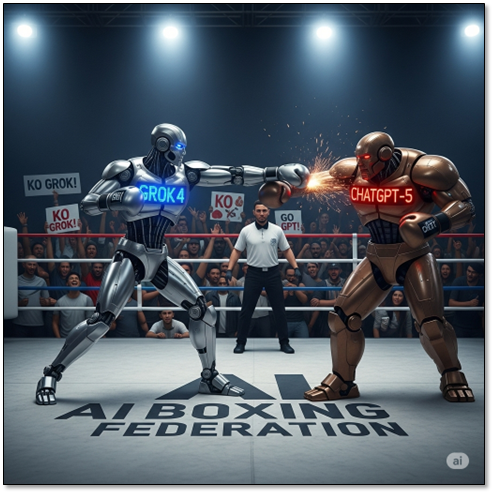
On August 8, OpenAI (pvt) launched GPT-5, according to the company “the greatest thing since sliced bread”, although others have called it an interim model with few improvements. That said, GPT-5 cites improved performance in a number of specialties (Math, science, finance, and law) at a PhD level, scored high on multi-modal tests and sees reduced hallucinations leading to less factual errors. All of these features generated enthusiasm and excitement but what we see as the most important feature is that OpenAI is providing GPT-5 to users for free, hoping to consolidate its base further. All (free and paid) users can access GPT-5, although access is limited for the free tier, at least for now.
Almost immediately xAI (pvt), owned by the great and powerful Elon Musk, announced that the latest xAI model GROK4 would now be free, having previously been available for a monthly fee to X Premium users and corporate API customers. Simply by choosing ‘expert mode’, GROK4 is now available to all, with Mr. Musk hoping to collect more interaction data and optimize Grok4 even further.
Will this whet the appetite of consumers and increase the subscription rate? We doubt it, in fact the more ‘free’ gets added to AI, we expect the more likely ‘free’ will be enough for most users and the subscription base will get narrower. While the model builders are focused on gaining share, consumers are focused on applications, essentially “What can AI do for me that I had to do myself previously?” and we see that as the only real AI business that consumers will pay for, although even that is a bit of a stretch as much of Google (GOOG) Play or the Apple Store points out (lots of free stuff). If it makes things easier or it keeps someone occupied when waiting at the DMV, it might have a chance, but paying to use a more sophisticated model when one is available for free is the path most taken unless you are a power user, and smart power users can take advantage of ‘free’ offers for as long as they are available…
Alas, conversion rates garnered by streaming services, which can run as high as 93% depending on content, are a dream for AI service providers and Gen Z subscribers, who one might assume would sign up to anything ‘AI’ seem to come in with conversion rates between 16% and 18%. But even ChatGPT, with the highest conversion rate among major AI providers, only generates ~5% fee-based conversions.
It is hard to translate conversion rates into sales and even harder to model ongoing costs as models evolve, but a recent occurrence does shed some light on how free to pay conversions are headed and it is not quite as positive as model builders might have hoped. Here’s what happened:
On August 8, OpenAI (pvt) launched GPT-5, according to the company “the greatest thing since sliced bread”, although others have called it an interim model with few improvements. That said, GPT-5 cites improved performance in a number of specialties (Math, science, finance, and law) at a PhD level, scored high on multi-modal tests and sees reduced hallucinations leading to less factual errors. All of these features generated enthusiasm and excitement but what we see as the most important feature is that OpenAI is providing GPT-5 to users for free, hoping to consolidate its base further. All (free and paid) users can access GPT-5, although access is limited for the free tier, at least for now.
Almost immediately xAI (pvt), owned by the great and powerful Elon Musk, announced that the latest xAI model GROK4 would now be free, having previously been available for a monthly fee to X Premium users and corporate API customers. Simply by choosing ‘expert mode’, GROK4 is now available to all, with Mr. Musk hoping to collect more interaction data and optimize Grok4 even further.
Will this whet the appetite of consumers and increase the subscription rate? We doubt it, in fact the more ‘free’ gets added to AI, we expect the more likely ‘free’ will be enough for most users and the subscription base will get narrower. While the model builders are focused on gaining share, consumers are focused on applications, essentially “What can AI do for me that I had to do myself previously?” and we see that as the only real AI business that consumers will pay for, although even that is a bit of a stretch as much of Google (GOOG) Play or the Apple Store points out (lots of free stuff). If it makes things easier or it keeps someone occupied when waiting at the DMV, it might have a chance, but paying to use a more sophisticated model when one is available for free is the path most taken unless you are a power user, and smart power users can take advantage of ‘free’ offers for as long as they are available…
 RSS Feed