Sony All-in on RGB Mini-LED
It seems that according to informed sources in Japan, Sony (SNE) has decided to adopt the latest advancement in LCD technology in a big way. The system, known as RGB (mini) LED is another push against OLED technology, which has been gaining recognition in IT devices. Although this technology has been shown at shows over the last few years, it was officially introduced at CES this year, with Hisense (600060.CH) showing a 116” model and Samsung (005930.KS) a 115” model. TCL (000100.CH), an early supporter of mini-LED/QD backlighting technology is thought to be developing an RGB mini-LED product for consumer release as part of its high-end line.
The purpose of RGB mini-LED backlight technology is to create a brighter set with more vivid colors while still using LCD technology, as opposed to the more expensive OLED process, which is known for its deep blacks and rich colors. Given the vast LCD infrastructure that has been developed over the last decade, LCD display producers are always looking to find better ways to compete with new or emerging display technologies and RGB LED is that next step.
In a typical mini-LED LCD TV, the backlight is made up of white or blue LEDs arranged in zones. As the light from these LEDs determines the maximum brightness of the set, one would think that the LEDs for such a backlight should be big and bright, but that is not always the case. 4K TV sets have over 8 million pixels, each able to generate a small part of the complete video frame, with their brightness theoretically based on the amount of light behind them (the LED backlight array). However, when the scene has both dark and light images, large LEDs leak light into dark pixels and turn them gray instead of black. In order to reduce this effect, mini-LED backlights use small LEDs grouped in zones that can be turned on or off zone by zone. While the zones don’t line up against the light and dark parts of the image, the fact that there can be many individually controlled zones, improves the light leakage issue. Further, each zone is comprised of multiple strings of LEDs (strings are a group of LEDs that work as one) that can be controlled string by string.
Logic holds that as the number of zones increases, the preciseness that the backlights can provide to the display’s millions of pixels improves, but more zones usually means smaller and more LEDs overall, which is why mini-LED sets tend to be more expensive than generic LED backlight sets. Behind all of these LEDs that are constantly being turned on and off (and many levels between) is the system that controls them. The basis for this system is the video processor, a specially designed chip that accepts video information before it hits the screen and reformats it to to the zone closest to that pixel set. Typically video processors look at this information on a frame-by-frame basis, which means they see brightness information on every pixel 30 times each second. Just one data point for each pixel would generate ~248 million data points each second so these processors are specially designed to provide a high-speed data stream. All of that data is passed on to the LED drivers whose channels are connected to the LED springs. Based on that massive amount of information, the LED zones are lit to try to correspond to the light and dark parts of every frame.
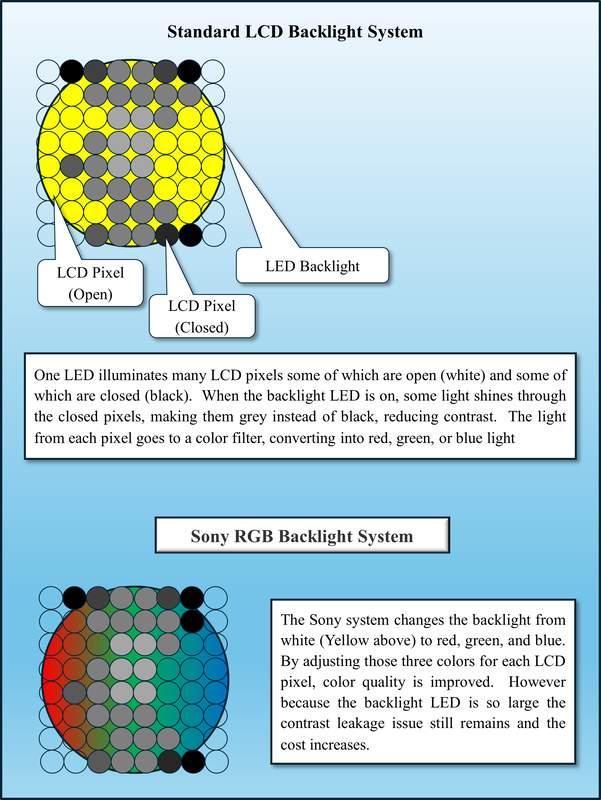
It’s a complex system that moves at millions of bits/second, but it’s all black and white. As the light from the LEDs passes through the liquid crystal pixels that open or close to create an image, on top of the pixels is a color filter, essentially a sheet of red, green, and blue dots. Each LCD pixel is made up of three sub-pixels, each of which correspond to a red, green, or blue dot on the color filter. By adjusting the amount of light that passes through the three LCD sub-pixels, each pixel can create any color. There is a problem however, in that the color filter is subtractive and reduces the overall brightness of the display as it subtracts two primary colors to create one from white LED light.
This system is the basis for every LCD TV, with Mini-LED backlight systems adding more LEDs to the mix, but what about the RGB LED backlight systems mentioned earlier? In order to reduce the subtractive effects of the color filter, display engineers decided that using colored LED backlights would reduce the amount of ‘filtering’ the color filter needed to do to create colors, and RGB LED backlights were born. But it is not as simple as it sounds. Now the video processor not only has to figure out what light level each string much have (30 times/sec.) but now has to figure out how to mix the three color strings in each zone to get closest to the color of that particular section of the image frame. Once it does those calculations for each zone and string for each frame, it sends the data to the drivers that generate the electrical charge. This means that instead of one white string in a particular zone, there are now three strings (RGB) and one driver now becomes three drivers.
The purpose of RGB mini-LED backlight technology is to create a brighter set with more vivid colors while still using LCD technology, as opposed to the more expensive OLED process, which is known for its deep blacks and rich colors. Given the vast LCD infrastructure that has been developed over the last decade, LCD display producers are always looking to find better ways to compete with new or emerging display technologies and RGB LED is that next step.
In a typical mini-LED LCD TV, the backlight is made up of white or blue LEDs arranged in zones. As the light from these LEDs determines the maximum brightness of the set, one would think that the LEDs for such a backlight should be big and bright, but that is not always the case. 4K TV sets have over 8 million pixels, each able to generate a small part of the complete video frame, with their brightness theoretically based on the amount of light behind them (the LED backlight array). However, when the scene has both dark and light images, large LEDs leak light into dark pixels and turn them gray instead of black. In order to reduce this effect, mini-LED backlights use small LEDs grouped in zones that can be turned on or off zone by zone. While the zones don’t line up against the light and dark parts of the image, the fact that there can be many individually controlled zones, improves the light leakage issue. Further, each zone is comprised of multiple strings of LEDs (strings are a group of LEDs that work as one) that can be controlled string by string.
Logic holds that as the number of zones increases, the preciseness that the backlights can provide to the display’s millions of pixels improves, but more zones usually means smaller and more LEDs overall, which is why mini-LED sets tend to be more expensive than generic LED backlight sets. Behind all of these LEDs that are constantly being turned on and off (and many levels between) is the system that controls them. The basis for this system is the video processor, a specially designed chip that accepts video information before it hits the screen and reformats it to to the zone closest to that pixel set. Typically video processors look at this information on a frame-by-frame basis, which means they see brightness information on every pixel 30 times each second. Just one data point for each pixel would generate ~248 million data points each second so these processors are specially designed to provide a high-speed data stream. All of that data is passed on to the LED drivers whose channels are connected to the LED springs. Based on that massive amount of information, the LED zones are lit to try to correspond to the light and dark parts of every frame.
It’s a complex system that moves at millions of bits/second, but it’s all black and white. As the light from the LEDs passes through the liquid crystal pixels that open or close to create an image, on top of the pixels is a color filter, essentially a sheet of red, green, and blue dots. Each LCD pixel is made up of three sub-pixels, each of which correspond to a red, green, or blue dot on the color filter. By adjusting the amount of light that passes through the three LCD sub-pixels, each pixel can create any color. There is a problem however, in that the color filter is subtractive and reduces the overall brightness of the display as it subtracts two primary colors to create one from white LED light.
This system is the basis for every LCD TV, with Mini-LED backlight systems adding more LEDs to the mix, but what about the RGB LED backlight systems mentioned earlier? In order to reduce the subtractive effects of the color filter, display engineers decided that using colored LED backlights would reduce the amount of ‘filtering’ the color filter needed to do to create colors, and RGB LED backlights were born. But it is not as simple as it sounds. Now the video processor not only has to figure out what light level each string much have (30 times/sec.) but now has to figure out how to mix the three color strings in each zone to get closest to the color of that particular section of the image frame. Once it does those calculations for each zone and string for each frame, it sends the data to the drivers that generate the electrical charge. This means that instead of one white string in a particular zone, there are now three strings (RGB) and one driver now becomes three drivers.
Mini-LED Driver Configuration - Source: SCMR LLC
RGB Mini-LED Driver Configuration - Source: SCMR LLC
This is where the trade-off of cost vs. quality becomes important. Driver ICs represent ~20% of the cost of the backlight system, so increasing the number of drivers increases the system cost and while the total number of LEDs can remain the same; in order to maintain the same number of zones in an RGB system, the number of LEDs could triple. The processor, which now handles considerably more information processing would likely need an upgrade, so the bottom line is that the cost of an RGB LED backlight system for LCD TVs will be higher than those currently used.
Sony does have an advantage over other brands, making it more obvious why they seem attracted to this new technology. They are the top of the premium TV price tiers and can absorb the higher cost more easily than some. As of now, with the only available RGB LED sets being over 100”, the additional cost means little, but it will when the technology gets down to smaller size TVs. Since the point is to compete with OLED, RGB LED TVs need to be at or below OLED premium levels, which will be difficult at the onset, so this new technology will need to prove itself in the quality arena which is Sony’s wheelhouse. More than likely Samsung and TCL will have the largest number of RGB LED backlit TV sets in terms of models, while Sony will have the premium (most expensive) sets, once this technology enters mass production (2026), but there has to be a meaningful difference in visual quality to measure up to the higher price, and that will be up to the consumer to decide. The current price of the Hisense 116” model in the US is $30,000 as is the 115” Samsung model. A ‘regular’ 115” Mini-LED TV is ~$20,000 and the largest LG (066570.KS) OLED TV (97”) is $18,000. Sony has a 98” LCD set that sells for ~$6,200 (MSRP).
Sony does have an advantage over other brands, making it more obvious why they seem attracted to this new technology. They are the top of the premium TV price tiers and can absorb the higher cost more easily than some. As of now, with the only available RGB LED sets being over 100”, the additional cost means little, but it will when the technology gets down to smaller size TVs. Since the point is to compete with OLED, RGB LED TVs need to be at or below OLED premium levels, which will be difficult at the onset, so this new technology will need to prove itself in the quality arena which is Sony’s wheelhouse. More than likely Samsung and TCL will have the largest number of RGB LED backlit TV sets in terms of models, while Sony will have the premium (most expensive) sets, once this technology enters mass production (2026), but there has to be a meaningful difference in visual quality to measure up to the higher price, and that will be up to the consumer to decide. The current price of the Hisense 116” model in the US is $30,000 as is the 115” Samsung model. A ‘regular’ 115” Mini-LED TV is ~$20,000 and the largest LG (066570.KS) OLED TV (97”) is $18,000. Sony has a 98” LCD set that sells for ~$6,200 (MSRP).
 RSS Feed