The Seven-Inch Ceiling: Will Smartphones Break the ‘Grip’ of Ergonomics?
The Phablet Paradox: When Is a Phone Not a Phone?
We all know what a smartphone is, or at least we think we do, but while foldable might have changed that definition a bit, there are some very specific delineations that describe the differences between smartphones and other device types. As far back as 2010 there were questions as to whether 7.0” tablets from Samsung Electronics (005930.KS) and ASUS (2357.TT) were actually tablets or phones as the manufacturers gave them the ability to make cellular calls (“P” designation in the model number) but were theoretically tablets. These devices, later called “Voice Tablets” pushed the screen size to 7” or greater, making them oddities at a time when smartphone screen sizes were
The 75mm Hard Limit: The Biological Reality of the One-Hand Rule
That said, there is a theoretical limitation to screen size for smartphones called the “One-Hand Rule”. Smartphone designers break down the surface area of a smartphone (right-handed) into three areas. The green zone arc is where the thumb typically rests and is easy to access. The yellow zone is reachable but usually requires a stretch or what is called a “Palm Shuffle” to move the phone slightly. The red zone, over 25% of the display, is inaccessible on phones over 6.9” (Diagonal), needing a second hand or requiring the phone to be pushed down far enough that it might slip. Older phones with displays under 5” had a “Green Zone” that covered ~90% of the display. A 7” display has a “Green Zone” of between 25% and 30%.
The width of the display is also a factor as you must be able to keep your fingers wrapped around the back of the phone while the thumb is moving. The limitation here is ~75mm (~3”) as a wider display causes your hand to grip so tightly that your thumb becomes restricted and the green zone shrinks.
Swords and Software: Engineering a Way Around the Human Hand
Manufacturers have found was around these limitations, primarily by changing the aspect ratio of the screen. Sony (SNE) changed the aspect ratio for its Xperia smartphone line, using a 6.5” display, to 21:9 from 2019 to 2023 to give users the larger screen (6.5” was large then) while still allowing the “One Handed Rule” to be maintained.
More recently, to compensate for even larger displays, smartphone manufacturers turned to software. Both the iOS and Android have applications that shrink the display when one swipes the bottom of the screen, allowing the thumb to reach the upper screen and Samsung has taken it even further by moving all interactive functions to the bottom of the screen, making them accessible to the thumb.
The "Large Grape" Advantage: The Hidden Power of Cubic Volume
While there are a number of ‘fixes’ that help users gain one-handed access, the physical limitations mentioned and others like pocket size and structural issues (larger screens are more liable to snap and need more internal support) have kept most smartphone displays below 7” and within a 77mm wide and 165mm high sweet spot. That said, it turns out that a number of smartphone manufacturers and examining the idea of new models that have displays above the 7” mark. Currently the few that exist (2025 – 2026) tend to be niche brands, although the Huawei pvt) Mate 70 Air, with its 7” display is the only current popular brand over the 6.9” limit.
As brands are always struggling with differentiating their phones from the vast number of competitive devices, any marketing hook can bring in a few more customers, but there are other reasons. While it seems minor, the additional space created by a 7” screen over a 6.8” screen (same width and thickness) is 3.7 cm3, and while that sounds small, it is the size of a large grape or a cherry and represents a 3.6% increase in smartphone volume. If that still sounds small, a smartphone engineer can increase the battery capacity in that situation from 4,300 mAh to 5,000 mAh, enough to bring the phone’s battery from ‘almost a day’ to ‘marathon’ level. It can also be used to double the size of the phone’s vapor chamber (cooling), allowing the phone to last an hour before it throttles down to cool, as opposed to the usual 10 minutes, or it could be used for an entire rear camera system, including sensors and lenses.
We all know what a smartphone is, or at least we think we do, but while foldable might have changed that definition a bit, there are some very specific delineations that describe the differences between smartphones and other device types. As far back as 2010 there were questions as to whether 7.0” tablets from Samsung Electronics (005930.KS) and ASUS (2357.TT) were actually tablets or phones as the manufacturers gave them the ability to make cellular calls (“P” designation in the model number) but were theoretically tablets. These devices, later called “Voice Tablets” pushed the screen size to 7” or greater, making them oddities at a time when smartphone screen sizes were
The 75mm Hard Limit: The Biological Reality of the One-Hand Rule
That said, there is a theoretical limitation to screen size for smartphones called the “One-Hand Rule”. Smartphone designers break down the surface area of a smartphone (right-handed) into three areas. The green zone arc is where the thumb typically rests and is easy to access. The yellow zone is reachable but usually requires a stretch or what is called a “Palm Shuffle” to move the phone slightly. The red zone, over 25% of the display, is inaccessible on phones over 6.9” (Diagonal), needing a second hand or requiring the phone to be pushed down far enough that it might slip. Older phones with displays under 5” had a “Green Zone” that covered ~90% of the display. A 7” display has a “Green Zone” of between 25% and 30%.
The width of the display is also a factor as you must be able to keep your fingers wrapped around the back of the phone while the thumb is moving. The limitation here is ~75mm (~3”) as a wider display causes your hand to grip so tightly that your thumb becomes restricted and the green zone shrinks.
Swords and Software: Engineering a Way Around the Human Hand
Manufacturers have found was around these limitations, primarily by changing the aspect ratio of the screen. Sony (SNE) changed the aspect ratio for its Xperia smartphone line, using a 6.5” display, to 21:9 from 2019 to 2023 to give users the larger screen (6.5” was large then) while still allowing the “One Handed Rule” to be maintained.
More recently, to compensate for even larger displays, smartphone manufacturers turned to software. Both the iOS and Android have applications that shrink the display when one swipes the bottom of the screen, allowing the thumb to reach the upper screen and Samsung has taken it even further by moving all interactive functions to the bottom of the screen, making them accessible to the thumb.
The "Large Grape" Advantage: The Hidden Power of Cubic Volume
While there are a number of ‘fixes’ that help users gain one-handed access, the physical limitations mentioned and others like pocket size and structural issues (larger screens are more liable to snap and need more internal support) have kept most smartphone displays below 7” and within a 77mm wide and 165mm high sweet spot. That said, it turns out that a number of smartphone manufacturers and examining the idea of new models that have displays above the 7” mark. Currently the few that exist (2025 – 2026) tend to be niche brands, although the Huawei pvt) Mate 70 Air, with its 7” display is the only current popular brand over the 6.9” limit.
As brands are always struggling with differentiating their phones from the vast number of competitive devices, any marketing hook can bring in a few more customers, but there are other reasons. While it seems minor, the additional space created by a 7” screen over a 6.8” screen (same width and thickness) is 3.7 cm3, and while that sounds small, it is the size of a large grape or a cherry and represents a 3.6% increase in smartphone volume. If that still sounds small, a smartphone engineer can increase the battery capacity in that situation from 4,300 mAh to 5,000 mAh, enough to bring the phone’s battery from ‘almost a day’ to ‘marathon’ level. It can also be used to double the size of the phone’s vapor chamber (cooling), allowing the phone to last an hour before it throttles down to cool, as opposed to the usual 10 minutes, or it could be used for an entire rear camera system, including sensors and lenses.
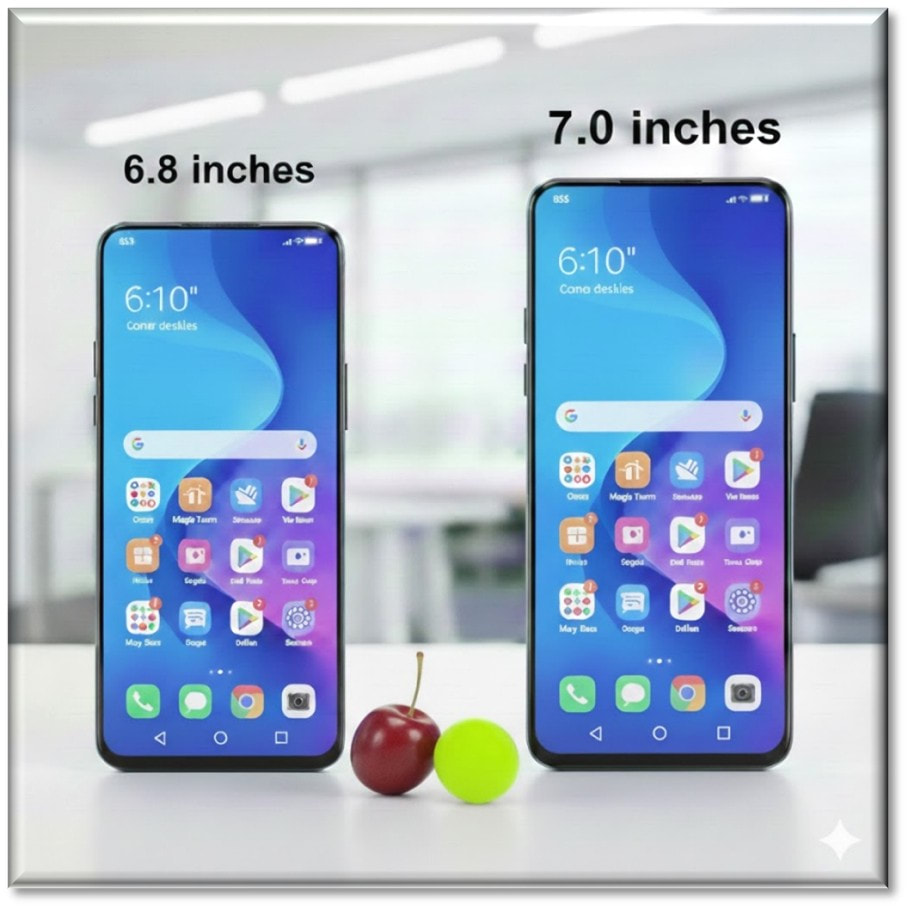
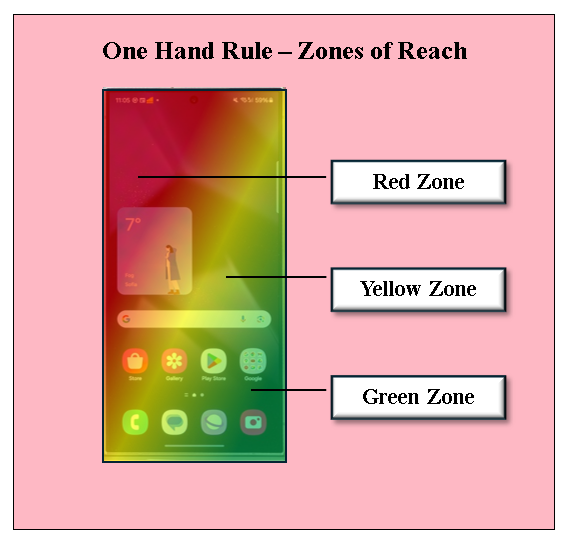
Figure 2 - One Hand Rule - Zones of Reach - Source: SCMR-LLC, Steven Hoober, Josh Clark
Conclusion: The 7-Inch Paradox
The evolution of the smartphone display has reached another interesting physical impasse. While the "One-Hand Rule" and the 75mm width limit define the boundaries of human ergonomics, the allure of the "Large Grape" volume, that extra 3.7cm3, is proving too tempting for manufacturers to ignore. This marginal increase in size represents a massive engineering victory, providing the breathing room needed for "marathon" batteries and superior cooling systems that 6.8-inch frames simply cannot house without compromise.
As we move through 2026, the industry appears to be splitting into two distinct philosophies:
The evolution of the smartphone display has reached another interesting physical impasse. While the "One-Hand Rule" and the 75mm width limit define the boundaries of human ergonomics, the allure of the "Large Grape" volume, that extra 3.7cm3, is proving too tempting for manufacturers to ignore. This marginal increase in size represents a massive engineering victory, providing the breathing room needed for "marathon" batteries and superior cooling systems that 6.8-inch frames simply cannot house without compromise.
As we move through 2026, the industry appears to be splitting into two distinct philosophies:
- The Foldable Solution: Traditional giants like Samsung and Apple (AAPL) are increasingly offloading the 7-inch-plus user experience onto foldables, using the "Book-style" form factor to bypass the pocket-leverage and thumb-reach issues entirely.
- The Candy bar Defiance: Niche players and brands like Huawei (via the Mate 70 Air) are doubling down on the "Mega-Screen" candy bar. They are betting that users will trade one-handed usability for the sheer utility of a device that finally merges the power of a tablet with the ubiquity of a phone.
 RSS Feed